A record that is longer than a single but shorter than an LP. It typically has a runtime of about 15 to 22, sometimes up to 30 minutes.
-
close
Extended Play (EP)
-
close
Quadraphonic sound
A surround sound system that uses four independent audio channels to create spatial sound reproduction. When playing quadraphonic audio, sound is distributed across four speakers – typically front left, front right, rear left, and rear right – to create a three-dimensional listening experience. Quadraphonic sound was popular in the 1970s but has mostly been replaced by modern multichannel systems like 5.1 and 7.1 surround sound.
-
close
Receiver
A device that receives, amplifies, and processes radio or audio signals for output. In audio contexts, often part of a hi-fi system.
-
close
Record
An analog storage medium where music or other audio recordings are etched in the form of grooves on a flat disc, typically made of vinyl. During playback, a needle tracks the grooves, converting the mechanical movements into audio signals.
-
close
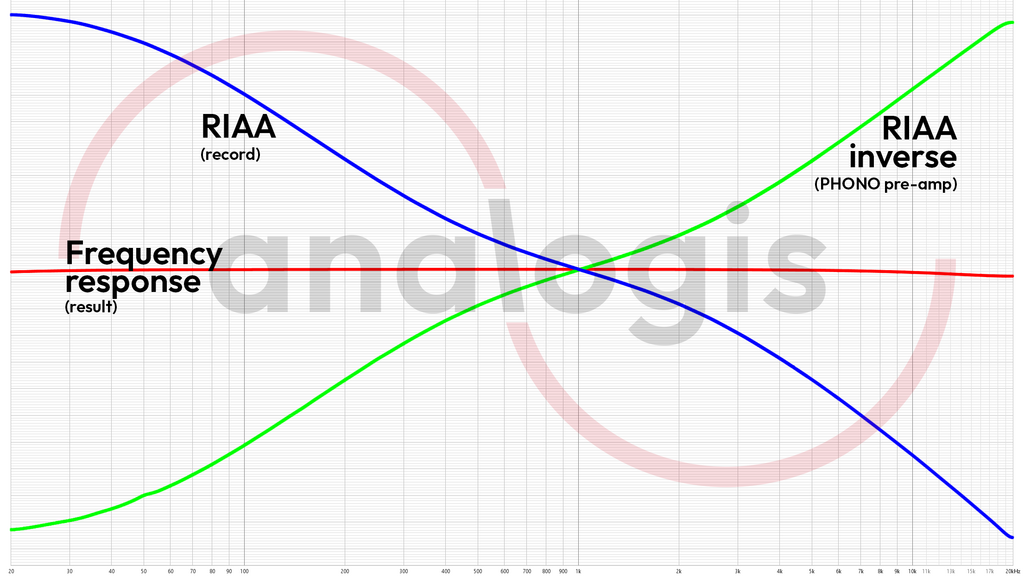
RIAA curve
A standardized frequency response curve that enables precise adjustments for vinyl record recordings. During recording, a filter is applied to reduce low frequencies and boost high frequencies to compensate for the physical limitations of the vinyl format. During playback, the reverse curve is applied to restore the sound to its original form and achieve a linear, flat frequency response.
-
close
RPM (Revolutions Per Minute)
The number of revolutions a turntable makes per minute. Common speeds are 33 1/3 RPM for LPs, 45 RPM for singles, and 78 RPM for shellac records.
-
close
Tape recorder
An analog recording and playback device that uses magnetic tape as a medium. It is commonly used for studio recording and archiving.
-
close
Vintage
Devices or music recordings from an earlier time, often valued for their historical significance or unique style.
-
close
Vinyl
A material from which most modern records are made. It provides better sound quality and durability than shellac.